
Addo Elephant National Park
Near GqeberhaMore than 600 elephants, Cape buffalo and endangered black rhino in a park founded in 1931. It covers about 1,640 square kilometres, under an hour's drive from Gqeberha.
Elephants and penguins, surf breaks and sea cliffs, Mandela's childhood home and a village of concrete owls. 48 places worth the drive, from the Karoo to the Wild Coast, with video of 39 of them.
Map outline: Natural Earth. Each place links to the source of its facts. Check opening times and road conditions before you travel.
Grouped by the kind of trip they make.
More than 600 elephants, Cape buffalo and endangered black rhino in a park founded in 1931. It covers about 1,640 square kilometres, under an hour's drive from Gqeberha.

Forest meets ocean along 80 km of protected coast. Walk to the suspension bridge over the Storms River mouth, or start the five-day Otter Trail here.

Proclaimed in 1937 to save the endangered Cape mountain zebra. Today 284 square kilometres of Karoo mountains and plains.

Just outside Graaff-Reinet, home to the Valley of Desolation, dolerite pillars shaped over 150 to 190 million years. Proclaimed a national park in 2005.

A wild valley between the Baviaanskloof and Kouga mountains, part of the Cape Floristic Region World Heritage Site. The wider reserve covers around 500,000 hectares.

A misty mountain village surrounded by indigenous Afromontane forest and waterfalls. Locals will tell you it inspired Tolkien, a story that is more legend than fact.

7,720 hectares of grassland, forest and coast on the northern Wild Coast. Home to a breeding colony of the threatened Cape vulture.

Coastal forest that has been protected since 1927, with a marine reserve offshore. About 290 bird species have been recorded here.
45,000 hectares of river valley and thicket along the Great Fish River, open since 1994.

A small 400 hectare reserve of forest and rocky shore, about 7 km south of Port St Johns.
A quiet coastal reserve of about 770 hectares, 30 km south of Port St Johns.

A private Big Five reserve of 250 square kilometres, established in 1992 on former farmland.
A rocky island in Algoa Bay with one of the largest African penguin breeding colonies. Bartolomeu Dias planted a stone cross here in 1488.

One of only six places in the world where Cape gannets breed. Algoa Bay is also visited by humpback and southern right whales and several kinds of dolphin.
The start of the 57 km Strandloper Hiking Trail to the Gonubie River mouth. The visitor centre stands on the ruins of an old titanium mine.

One of the most famous surf towns in the world. The wave at Supertubes can run for 300 metres or more.

A seaside village with the Seal Point Lighthouse, featured in the 1966 surf film The Endless Summer.

One of the city's most popular swimming beaches, with Shark Rock Pier, the only pier in Nelson Mandela Bay.

A holiday town between the Bushmans and Kariega rivers, roughly halfway between Gqeberha and East London.

A town at the mouth of the Kowie River, where a stone-lined harbour channel was built in the 1840s.
A small seaside village 38 km north-east of East London.

The southern gateway to the former Transkei. In 1930, Huberta the famous hippo made her home in the Kei River here.

Named, the story goes, after coffee trees that grew from beans washed ashore from a shipwreck. A base for exploring the Wild Coast.

A huge arch the sea has cut through a cliff. Local people call it esiKhaleni, the place of sound, for the roar of the waves.

The Umzimvubu River flows through the Gates of St John gorge to the sea here. Visitors come for the beaches and tours of the famous sardine run.

An award-winning museum of the struggle against apartheid, opened in 2006 in one of South Africa's oldest townships. Its stories are told in twelve rusted memory boxes.

A stone fort built in 1799 to guard against a French invasion. Nearby in the city centre are the Donkin Reserve pyramid and lighthouse, and Route 67, a trail of 67 public artworks honouring Mandela.

The village where Nelson Mandela was born on 18 July 1918.

Where Mandela spent what he called the happiest moments of his childhood. He was buried here on 15 December 2013.

The Bunga Building tells the story of Long Walk to Freedom and shows gifts Mandela received from around the world. The museum's other sites are at Mvezo and Qunu.
Founded in 1916, it taught Nelson Mandela, Oliver Tambo, Robert Sobukwe, Desmond Tutu, Chris Hani and future leaders from across Africa.

Steve Biko lived in Ginsberg in the 1970s. The centre, opened in 2012, holds the Steve Biko Garden of Remembrance.

On 7 September 1992, Ciskei soldiers opened fire on a march of about 80,000 people. 29 people were killed.

Home of Matthew Goniwe, Fort Calata, Sparrow Mkonto and Sicelo Mhlauli, abducted and killed in June 1985. A Garden of Remembrance stands on the N10 between Cookhouse and Cradock.
Born near the Gamtoos River in 1789 and exhibited in Europe, she was finally brought home and laid to rest on a hill above Hankey on 19 August 2002.
Renamed in 2018 after the Xhosa prophet and warrior Makhanda ka Nxele. Every June and July it hosts the largest arts festival on the continent, centred on the 1820 Settlers Monument.

Helen Martins filled her home and garden with ground glass and more than 300 concrete owls, camels and figures, the inspiration for Athol Fugard's The Road to Mecca. In the same village, the Kitching Fossil Exploration Centre shows reptiles that lived here about 253 million years ago.

Founded in 1786, it has more national monuments than any other town in South Africa.
Holds the type specimen of the coelacanth, a fish believed extinct until Marjorie Courtenay-Latimer, who worked at the museum, discovered it.

The Mpondo name means place of smell, after the sulphur springs. People come for the mineral-rich clay.
One of South Africa's key citrus-growing areas, watered by canals that run from Kirkwood down to Addo.
A farming town at the centre of citrus, tobacco and vegetable farms.

A 160 km valley prized for its apples and pears, with farm towns such as Joubertina along the way.

One of South Africa's most important chicory areas, also known for pineapples and dairy. Nearby is one of the largest active dune fields in the world.

The world's highest commercial bridge bungy, from a bridge 216 metres above the Bloukrans River.

A ski resort at about 2,720 metres on the slopes of Ben Macdhui, the highest mountain in the Eastern Cape.
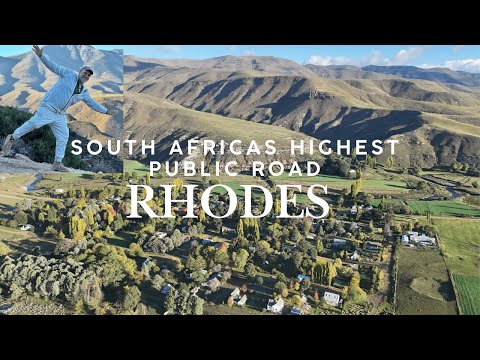
A mountain village at 1,832 metres, home of the Wild Trout Festival on the rivers around it.

South Africa's largest sea cliff climbing spot, with more than 600 routes above a long, lifeguarded beach.
Video stills and videos belong to their creators on YouTube and play in privacy-enhanced mode when you press play. Facts link to their sources.
The Wild Coast is the traditional home of Xhosa-speaking peoples, among them the Gcaleka, Thembu, Mpondo and Bomvana. Mandela was born at Mvezo and grew up in Qunu. Makhanda carries the name of the Xhosa prophet Makhanda ka Nxele. Every place on this map has neighbours who know it best.
Know a beach, a farm stall, a heritage site or a view we should add? Send it to us with a link to where we can read about it.